

Influences &
Research Notes
For anyone curious to know where historical titbits came from, or just keen on the period, here are some resources.

The New Women of Mayfair novels are strictly for entertainment…no further reading is required!
I’m always looking for recommendations so, if there’s something you think would add to this list, please email and let me know.
It will be clear that the fiction of Edith Wharton, Oscar Wilde, Anthony Trollope and even John Mortimer has been an influence (Trollope’s barrister Chaffanbrass gets a cameo in Georgia’s Lesson, as does Rumpole’s nemesis Judge Bullingham). Elizabeth Gaskell’s ‘North and South’ features in Georgia too. There are less well remembered writers of the period who engaged more directly in the ‘New Women’ question. I’d recommend Elaine Showalter’s wonderful collection ‘Daughters of Decadence: Women Writers of the Fin de Siècle’ for anybody curious.
The list below was all used for specific research:
MV Hughes: Molly Hughes was one of the first women to focus on the education of women’s teachers. She wrote three amazing memoirs late in life. ‘A London Girl of the eighties’ and ‘London home in the nineties’ are fabulous resources. Most evident in the story of Georgia.
The Bitter Cry of Outcast London: a long pamphlet published anonymously, now attributed to minister Andrew Mearns and journalist William Carnall Preston. Granular detail on the extremes of poverty in late nineteenth century London. Not for the faint hearted.
Margaret Harkness: Harkness wrote social diatribes dressed up as novels under the pen name John Law. They’re not the best stories, but for anybody who wants to get angry about social deprivation of the period, they are gold dust. Out of Work describes the Bloody Sunday in Trafalgar Square of 13 November 1887 (much of the detail is borrowed for the 1896 demonstration Georgia attends). A Manchester Shirtmaker describes in heartbreaking detail just how bad working conditions were in the textile trade.
George Gissing: ‘The Odd Women’. Again, not an especially brilliant novel, but an incredible piece of social writing. Gissing focusses on a specific slice of society - unmarried, educated women and their struggles, both financial and social.
Jerry White’s London in the Nineteenth Century is a wonderful book, often referred to by the excellent pair behind The Rest is History podcast. I’ve listened to their multi-episode descriptions of the Jack the Ripper tragedy and Oscar Wilde trial with great interest.
King’s Handbook of New York City 1892: accessible through Google Books. A treasure trove of detail. If you want to know how Isabella and Caspar choose the ideal pond for skating in Central Park in 1895, the detail is here.
Andrew Roberts: Salisbury, Victorian Titan. Lord Salisbury was Prime Minister for most of my period (longer serving than Gladstone, a little less than Lord Liverpool, earlier in the century). Robert’s 900 page biography is gripping reading (for context on how much was going on at the time…the annexation of Burma receives less than a single page). Watch this space for a future novel, inspired by Robert’s brief description of Lord Salisbury’s late-in-life discovery of the motorcar…
Kathryn Atherton’s book ‘Mary Neal and the Suffragettes Who Saved Moris Dancing’ is a wonderful book. Mary Neal is such an inspiration she features directly in both ‘Georgia’s Lesson’ and ‘Eleanor’s Gamble’.
Henry Mayhew’s ‘London Labour and the London Poor’ is a famous work of sociology. I’m so indebted to him that I gave his surname to my *journalist* Brian Mayhew in ‘Georgia’s Lesson’ (no disrespect intended to the great Henry).
Isabella’s Mission has a key chapter set at the first ticketed women’s football match in England, organised by the wonderful Nettie Honeyball (features in Isabella’s Mission and Georgia’s Lesson) and Lady Florence Dixie (who features in all three books).
The match has been much discussed - I took much of the detail from The Guardian and BBC:
https://www.bbc.co.uk/news/uk-scotland-highlands-islands-24176354

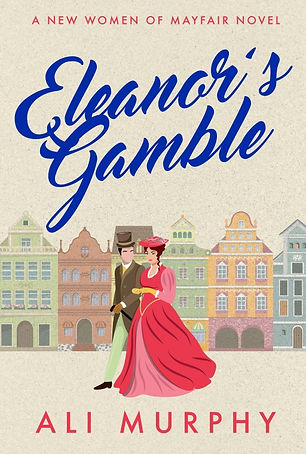


Eleanor's Gamble
Eleanor Booth needs two things from London: a million-pound loan to save her family’s mining venture, and absolute certainty that her embarrassing adolescent crush on Charles Doherty is dead and buried.
Armed with ledgers, sharp wit, and American resolve, Eleanor has no intention of relying on aristocratic patronage.
Georgia's Lesson
Georgia Burrows arrived in London with sharp principles and a disgraced past. Exiled from Cumberland, she takes a post teaching the daughters of privilege in Kensington, throwing herself into the capital’s underground labor and suffrage movements to survive.
The last complication she needs is Lord Jacob Worthing.
Isabella's Misson
Isabella Thorpe has a remedy for everyone’s troubles—except her own.
Sent from Manhattan to Mayfair to give her exasperated father some peace, she takes on the chaotic Braithwaite household with brisk efficiency.
Organising a wayward brother, a rebellious suffragist, and the heir’s ill-advised engagement should be child's play.
